Thursday, October 4, 2012

Week 6: Status and Worth/ Subversion of Empire/Collages

  What a great last class.. I will really miss you all. 

Look forward to some great Philemon papers in my email soon!

--

.Class vote results:
?


When Jesus died, he:


A) died naked (but not in Christian art and movies) to subvert shame

I am not here to offend anyone unnecessarily.
But I believe Corrie Ten Boom was right and right on:

Jesus died naked.

Even the (very conservative) Dallas Theological commentaries assume this, so this is not just some "liberal" agenda:


"That Jesus died naked was part of the shame which He bore for our sins. " -link


Which means this picture
(found on a blog with no credit)
is likely wrong(Jesus looks too white).

...and largely right (What Jesus is wearing).

I answered a question about this a few years ago, I would write it a bit differently know, but here it is:

First of all, it is probable that (again, contrary to nearly all artwork and movies), Jesus hung on the cross absolutely naked. This was a typical way of crucifixion, to increase the shame factor. Romans might occasionally add a loincloth type of garment as a token concession and nod to Jewish sensitivity; but not very often, it would seem. Of course, once we get past the emotive and cultural shock of imagining Jesus naked, we realize that if He indeed die naked, the symbolism is profound and prophetic: In Scripture, Jesus is called the "Second Adam". As such, it would make sense that He died "naked and unashamed." We are also told that "cursed is he who dies on a tree." The nakedness was a sign and enfolding of shame and token of curse. And the wonderful story of Corrie ten Boom and family, told in the book and movie "The Hiding Place," relates. One of the turning points of her ability to endure the Ravensbruck concentration camp, particularly the shame of walking naked past the male guards, was her conviction that Jesus too was shamed and stripped naked before guards. "Finally, it dawned on me," she preached once," that this (shaming through nakedness) happened to Jesus too..., and Jesus is my example, and now it is happening to me, then I am simply doing what Jesus did." She concluded, "I know that Jesus gave me that thought and it gave me peace. It gave me comfort and I could bear the shame and cruel treatment." 
continued

Stephen Seamands, in "Wounds That Heal," (much of it a free read here) stirs me to wonder if shaming is always perpetrated in two stages:

1)forced/involuntary/public nakedness (literal or emotional) nakedness of soul may be even worse)
2)the promise of continued shaming beyond death (by dishonoring our name after we are gone, or sending us to hell in the afterlife ).


Seamands quotes the most important theologian you have never heard of, Frank Lake, and that section reminds how vital it might be to doggedly defend the doctrine (that most evangelicals seem to think is unspeakable.... even though as we mentionedh very conservative Dallas Seminary professors claim it is necessary, let alone Martin Hengel in his classic book "Crucifixion)"that Jesus died completely naked...especially that he might completely identify with, incarnate; convert and subvert our shame, particularly of sexual abuse or memories:
Crucifixions were purposely carried out in public..Executioners heightened the shame by turning the gruesome personal ordeal into grisly public entertainment.. In most paintings, films and artistic depictions, the crucified figure of Jesus is partially covered with a loincloth. But in the ancient world, the victim was always crucified naked. The shameful exposure often continued after death since it was common for the victim to be denied burial.. Hengel explains, ...'What it meant for man in antiquity to be refused burial, and the dishonor that went with it, can hardly be appreciated by modern man.' ...Frank Lake expresses the truth powerfully in describing Christ's experience of shame in nakedness: 'He hangs on the Cross naked. Both the innocent who were not loved and the guilty who have spurned love are ashamed. Both have something to hide. Clothing is the symbol of hiding what we are ashamed to reveal. In His own innocence He is identified with the innocent in nakedness...He was so deprived of His natural clothing of transfigured beauty and glory that men, seeing Him thus, shrank away from Him. The whole world will see this King appearing in all beauty and glory, because He allowed both..to be utterly taken away.' -Seamands, pp 49-50
More posts on Jesus dying naked?  See:.
 "The Last Temptation of Movie Boycotters,"

That some well-meaning folks suggest we should never mention his nakedness,
 that doing so is so wrong as to be satanic...
 that we should fear thinking about genitalia,
 is represented here:

That he may have been naked is as about as important as what kind of nails were used to nail him there. Copper? Bronze? Iron? Who cares?! Was the crown of thorns made of Briar thorns or Thistle? Who cares?

Did Jesus die? Who cares? (Bear with me).

Did Jesus lay down his life willingly and by his own power, and then take it back up again just as willingly and just as powerfully? THAT is the point.

Don't get distracted by images of genetalia! [sic] And let's face it; as soon as you hear someone say "Jesus died naked on a cross", that's the first thing that pops into your carnal, fleshly, sinful mind. As soon as you hear it, you are IMMEDIATELY distracted.
That man who is telling you that may not know that he's being used as a servant of Satan; but he is.
-link
Of course, I feel for this position, and am aware that the naked Jesus doctrine could be terribly abused...But I fear that ironically, it may be crucial to recover/uncover.
It may not be a "required doctrine,"....but..

Anyway..

Several pages later, Seamands, in a discussion on the practical relevance of the Trinity (Note:see his entire wonderful book on this important topic):


'My God, My God, why have you forsaken me?' On the cross, Christ gave expression not only to his own sorrow and disappointment, and ours, but also to God's...At the foot of the cross, our mournful cries of lament are always welcome...

...This cry is the only place in the gospels where Jesus didn't address God with the personal, intimate, 'My Father,'...

..On the cross, the bonds of trust between the Father and the Son seem to disintegrate. As theologian Jurgen Moltmann says, 'The love that binds the one to the other is transformed into a dividing curse.'....Yet at the cross, the Father and the Son are never more united, never more bound together. They are one in their surrender, one in their self-giving. The Father surrenders the Son...The Son, in turn, surrenders himself...So {they} are united even in their separation, held together by their oneness of will and purpose
-Seamands, 67-68
More on the dynamics of God forsaking God here, and more on the trinitarian centrality of all this by clicking the "trinity" label below this post.

Finally, Seamands helps me grasp that Jesus died not only for our shame, but our rage
(rage, of course, is often enacted as a reaction to shame). Rage, ironically, is what literally killed Jesus (and shamed him into nakedness):

Christ became the innocent, willing victim of their rage. But not only their [those at the cross] rage -ours too. Frank Lake is right: 'We attended the Crucifixion in our crowds, turned on our Healer..' -Seamands, 69
Which of course, leads to Jesus healing us precisely when we deserve it least and need it most.
Naked and (un)ashamed.

-------

More:


B)subverted empire:

The early Christian church, living as an

  • alternative
  • counter-cultural
  • Upside Down Kingdom
 community and communitas (within the Matrix/ Roman Empire; in but not of it)
had to decide how to respond to the empire/emperors.
Here below are two "literary/historical world" examples of one of their key responses:

Subvert/satirize it.
(How do you compare this response to culture/government/empire
to those of the Pharisees,Sadducces, Zealots and Romans


a)The Crucifixion/Resurrection accounts in the gospels:
Especially in Mark,  the "Literary world" styling and "Historical world" background  ofJesus' crucifixion scene seems set up to satirize empire, and encourage subversion. Here is a summary below from Shane Claiborne's book, "Jesus For President":

Coronation and Procession (8 steps):
1. Caesar: The Praetorian guard (six thousand soldiers) gathered in the Praetorium. The would-be Caesar was brought into the middle of the gathering.
1. Jesus: Jesus was brought to the Praetorium in Jerusalem. And the whole company of soldiers (at least two hundred) gathered there.
-----------------
2. Caesar: A purple robe was placed on the candidate. They were also given an olive-leaf wreath made of gold and a sceptre for the authority of Rome.
2. Jesus: Soldiers brought Jesus a wreath (of thorns), a sceptre (an old stick), and a purple robe.
-------------------
3. Caesar: Caesar was loudly acclaimed as triumphant by the Praetorian Guard.
3. Jesus: Sarcastically, the soldiers acclaimed, mocked, and paid homage to Jesus.
----------------
4. Caesar: A procession through the streets began. Caesar walked with a sacrificial bull and a slave with an axe to kill the bull behind him.
4. Jesus: The procession began. But instead of a bull the would-be king and god became the sacrifice and Simon of Cyrene was to carry the cross.
----------------
5. Caesar: The procession moved to the highest hill in Rome, the Capitolene hill (‘head hill’).
5. Jesus: Jesus was led up to Golgotha (in Aramaic ‘head hill’).
----------------
6. Caesar: The candidate stood before the temple altar and was offered a bowl of wine mixed with myrrh, which he was to refuse. The wine was then poured onto the bull and the bull was then killed.
6. Jesus: He was offered wine, and he refused. Right after, it is written, “And they crucified him.”
----------------
7. Caesar: The Caesar-to-be gathered his second in command on his right hand and his third on his left.
7. Jesus: Next came the account of those being crucified on his right and left.
----------------
8. Caesar: The crowd acclaimed the inaugurated emperor. And for the divine seal of approval, the gods would send signs, such as a flock of doves or a solar eclipse.
8. Jesus: He was again acclaimed (mocked) and a divine sign confirmed God’s presence (the temple curtain ripped in two). Finally, the Roman guard, who undoubtedly pledged allegiance to Caesar, the other ‘Son of God’, was converted and acclaimed this man as the Son of God.
---------------------- 
This extraordinary symbolism would have been unmistakable to the first readers of the Gospel. The crown of thorns, the purple robe, the royal staff; the whole section leading up to the crucifixion reads like the coronation of Jesus! At the apex of this passage is the Roman Centurion’s exclamation that “Surely this man was the Son of God!” He saw how Jesus died and became the first evangelist. His realisation tears apart his whole view of the world and reveals the fallacy of earthly empire and the nature of the true King.
Mark is trying to show us where our allegiance should lie. At the foot of the cross, when even those that Jesus loved must have been bewildered (only failed Messiahs hung on crosses), a Roman Centurion proclaimed that Jesus was the Son of God! The journey to the cross was the final coronation of the Son of God, the rightful King, who in the cross defeated sin and death.
-Link: Shapevine 

BONUS:  

  • Here's a Ray VanDer Laan article that Shane Claiborne drew from in the coronation article above..
  • Here is a podcast interview Keltic Ken and I did with Shane Claiborne.

Book of Revelation:
Here below is a Rob Bell sermon that presents the book of Revelation as subversion of empire; many do not realize that the "historical world" of this book has much to do with persecution by emperors for not worshipping them: 


-----------------
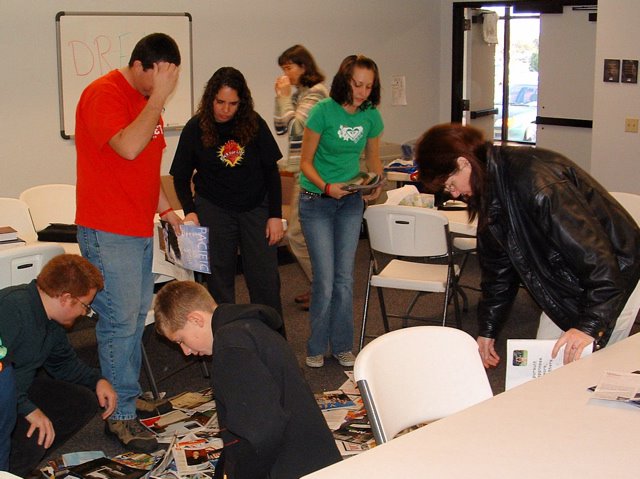
Collages: awesome job!


One of my seminary professors, the right-brain and right-on Chuck Killian, in a "Storytelling and Preaching" class, had us make collages...ripping out any pictures or text that got our attention from magazines, and assembling collages. Of course, it was hilarious to see all the distinguished graduate theological students walking the halls of academia with..not a two-ton stack of theological texts..but collages (I think we even had homework involving crayons once!): "Oh, you're in Killian's class, I see!," the smirking passersby would goodnaturedly tease. But what other seminary assignment do all of us still remember vividly..and what other assignments from seminary were "off the wall" enough to still be literally somewhere on our wallsl these years later? It was a creative way to get in touch with ourselves, our spiritual life, our darkest demons, wildest hopes...and our dreams.

We would simply wander around the impromptu art studio and ask a brother or sister, "Tell me about your collage." And we listened, and learned. It was sacred. Each collage was like an X-ray of the person's soul; fears; dreams.
Some interesting questions were: Why is every white space on your backdrop covered, while your husband's collage had tons of white space/room between pictures? Does this picture you chose remind you of someone you know? Some intriguing observations: a variety of styles (meticulously angled pictures vs. random). And some artistic choices were fairly obvious to unpack. For example, It doesn't take a rocket scientist, or trained pyschoanlayst to discern that peole often placed images/text relating to their central heart-commitments (Christ, family) in the center of their collage.

I have not been able to google the source on this next part of the "collage interpretation," (or hardly anything on this type of collage, period..except for maybe this),
so maybe it was Chuck Killian's own. But he suggeted that we might unconsciously divide our collage into four quadrants, with
each quadrant possibly representing images/impressions from different seasons of one's life. He suggested that the lower left may be where people place images reminding them of their
]past; the upper right, their present; lower right, near future; and upper left, far future. Now this is not to be an infallible Freudian grid, or some kind of holy Rorshach test, but I have always founded that this grid has validity in many cases, and in a few cases radically connects dots...even changed lives as tears and memories flowed. Again, not that this overlay is perfectly prophetic, but it is worth putting into the mix.


-----

Book recommend:

"Jesus: A Theography"

Some books seem impossible to review...other than to say they  are amazing, make my top ten list., and everyone should own it.

Such is the case with "Jesus: A Theography," by Leonard Sweet and Frank Viola, a book that creates a word...and a genre.

I don't know where to start, so I'll start at the beginning...and the end.


And the middle:
  • The entire book was checked by the master, Craig Keener...and they took all his suggestions!  That alone would make it a six (out of five) star book.
I an tempted to  turn it up to eleven,
but I'll give it a ten..
Buy the book already..

Thursday, September 27, 2012

Week 5

  • Quiz:
  • a  inclusio
    b   chiasm
    c  fuzzy set
    d Kingdon
    e  centered set
    f   bounded sert
    g  drop-down box
    h Middle Zone
    i  six dregrees of separatio
    j  three worlds
    k  intertextuality/hyperlinking
    l   recurrence
-We'll watch the second half of "Drops Like Stars" (full video posted on last week's post


----------------
 tonight's Bible theme is PROPHECY and WISDOM..and the symbol is:


The first three circles are
SUBMITTING TO SOVEREIGNTY
SUBVERSION OF EMPIRE
TEMPLE TANTRUM
-----
SUBMITTING TO SOVEREIGNTY


:"I Surrender to Your Will":

See the article you read in class:

Salt Fresno March 2012

"My only sermon  p. 40 "here

or   PDF version here

The Anne Lammott "sinner's prayer":
And one week later, when I went back to church, I was so hungover that I couldn’t stand up for the songs, and this time I stayed for the sermon, which I just thought was so ridiculous, like someone trying to convince me of the extraterrestrials, but the last song was so deep and raw and pure that I could not escape . It was as if the people were singing in between the notes, weeping and joyful at the same time, and I felt like their voices or something was rocking me in its bosom, holding me like a scared kid, and I opened up to that feeling–and it washed over me.
“I began to cry and left before the benediction, and I raced home and felt the little cat running along at my heels, and I walked down the dock past dozens of potted flowers, under a sky as blue as one of God’s own dreams, and I opened the door to my houseboat, and I stood there a minute, and then I hung my head and said, “Fuck it: I quit.” I took a long deep breath and said out loud, “All right. You can come in.”
So this is the beautiful moment of my conversion.” link


---
TEMPLE TANTRUM:

NT Wright on the temple:
Jesus as New Temple:


Three thought experiments.
  • -Think if I offered you a drivers license, claiming  i had authority to issue it
  • -Think if someone destroyed all bank records and evidence of any debt you have owe
  • -Think  what would happen if you pointed at something, hoping your dog would look at it.
Now watch this short  and important video above  for explanations:


N.T. Wright, "The Challenge of Jesus":


Jesus’ clash with the Pharisees came about not because he was an antinomian or because he believed in justification by faith while they believed in justification by works but because his kingdom-agenda for Israel demanded that Israel leave off her frantic and paranoid self-defense, reinforced as it now was by the ancestral codes, and embrace instead the vocation to be the light of the world, the salt of the earth. I therefore propose that the clash between Jesus and his Jewish contemporaries, especially the Pharisees, must be seen in terms of alternative political agendas generated by alternative eschatological beliefs and expectations. (58)


His attitude to the Temple was not "this institution needs reforming," nor "the wrong people are running this place," nor yet "piety can function elsewhere too." His deepest belief regarding the temple was eschatological: the time had come for God to judge the entire institution. It had come to symbolize the injustice that characterized the society on the inside and on the outside, the rejection of the vocation to be the light of the world, the city set on a hill that would draw to itself all the peoples of the world. (64)


…Jesus acted and spoke as if he was in some sense called to do and be what the Temple was and did. His offer of forgiveness, with no prior condition of Temple-worship or sacrifice, was the equivalent of someone in our world offering as a private individual to issue someone else a passport or a driver’s license. He was undercutting the official system and claiming by implication to be establishing a new one in its place. (65)  NT WRIGHT

See:


Jesus the Temple

Jesus and the Temple Destruction: Did Jesus say he would destroy the temple?


1"So What?" for Nurses

We'll spend some time asking the "SO WHAT?" question about everything we've been  learning so far..
What do things like chiasm,    Herod's fortress, weddings on Mount Sinai, cross-cultural comedians who "get their sushi at 7-11 etc  have to do with your daily "contemporary world" of nursing?

Discussion about our Chapman textbook (that you wrote about )should help.


----

Click the title below to read a related hilarious story:
one of my all-time favorite stories. Unfortunately, it's true!
From Eugene Peterson's "Under the Unpredictable Plant:

Sex and Drugs in Church: Peterson on Why the System Can't Care


---


Homework Help:

1)Bring magazines next week

2)Take a look at some of my albums of  fiunny and misspelled signs,
and text me one of your own (a funny sign you take a picture of or find online) by next class
Which "sign" of mine from the two "sign" albums assigned to your party is your favorite, and why
2)What funny sign dis you find on campus (hopefully mistake or misspelled).

P


Thursday, September 20, 2012

Week 4: Worshipping in Community.-Psalms-Temple Tantrum-Drops Like Stars part 1


Remember to bring stacks of magazines next two weeks:


In light of your church visit from 300B (see bottom of page), here is "Bad Vicar": 

"Devotions" from the famous theologians Cheech and Chong (in the ER):


--

 We are coming into the home stretch, and you are doing great!

This week, the topic is "Worshipping in Community."

First of all, in a Hebrew mindset, "Everything is Spiritual"...

(which is very different from "It's all spiritual")..
PSALMS
PSALMS are the Jewish prayer-book (Rob Bell called it a "book of poems")  that the early Christians used.  What's wonderful, refreshing, honest...and sometimes disturbing  (to us in the West) is that they cover the whole breadth of life and emotion.  They are all technically songs and prayers..  But note how some weave in and out from a person speaking to God, God speaking to a person, a person speaking to himself.  Somehow, Hebraiclly, holistically, it all counts as prayer.

...And as "song"  Note in your Bible that several psalms have inscriptions which give the name of the tune they are to be prayed/sung to.  Some seem hilarious, counterintuitive, and contradictory, but again not to a Hebrew mindset and worldview, with room for honesty,fuzzy sets and paradox:

  • Psalms  (click) with the line "Destroy my enemies", "break their teeth!!" ... To be sung to the tune of "Do Not Destroy"  !!
  • Psalm 22, a depressing ditty about someone in the throes of rejection despair and death.  To be sung to the tune of "Doe in the Morning"   ??
Can you name contemporary songs where the music doesn't seem to fit the lyric?  Down lyrics to upbeat music?  Vice Versa?  How might that  be healing/helpful/Hebrew/holy?  and not Hellenistic?

Remember the Bono quote:

Click here for the audio (or watch here on Youtube) of this delightful statement by Bono:

"God is interested in truth, and only in truth. And that's why God is more interested in Rock & Roll music than Gospel... Many gospel musicians can't write about what's going on in their life, because it's not allowed .  they can't write about their doubt....If you can't write about what's really going on in the world and your life, because it's all happy-clappy... Is God interested in that? I mean, 'Please, don't patronize Me! I want to go the Nine-Inch-Nails gig, they're talking the truth!
-Bono

From a 2003 discussion with New York Times, more audio here


"The Jewish disciples all worshipped Jesus, and some of those worshippers doubted."  (matthew 28:17)

"The opposite of faith is not doubt, but certainty."  -Anne Lammott

-

---------

There are several ways to categorize the psalms.

The first is the way the Bible itself does: Psalms is broken down into 5 "books"  Hmm, 5...does that sound familiar?  Name another book with 5 sections and suggest an answer for "Whats up with the number 5?"
Note the 5 sections are not comprised of different kinds/genres of psalms..but the styles and kinds are "randomnly"
represented throught the book..
kind of like life..


  Here is one way to categorize the styles and genres:

 Walter Brueggemann  suggests anotherhelpful way to categorize the Psalms.

 Orientation:
o      Creation - in which we consider the world and our place in it
o      Torah - in which we consider the importance of God's revealed will
o      Wisdom - in which we consider the importance of living well
o      Narrative - in which we consider our past and its influence on our present
o      Psalms of Trust - in which we express our trust in God's care and goodness

q        Disorientation:
o      Lament - in which we/I express anger, frustration, confusion about God's (seeming?) absence
§       Communal
§       Individual
o      Penitential - in which we/I express regret and sorrow over wrongs we have done
§       Communal
§       Individual

q        Reorientation
o      Thanksgiving - in which we thank God for what God has done for us/me
§       Communal
§       Individual
o      Hymns of Praise - in which we praise God for who God is
o      Zion Psalms- in which we praise God for our home
o      Royal Psalms - in which we consider the role of political leadership
o      Covenant Renewal - in which we renew our relationship with God
                                          -Bruggeman, source Click here.

 note how astonishingly HONEST the prayer/worship book of the Jews (and Christians) is!
-----------------------
We'll spend some time on the "three worlds" of Psalm 22, which Jesus quotes  honestly  on the cross:

Here (click title below) 's a sermon on Psalm 22, which is another amazing psalm to use in a worship setting...How often have you heard "My God, My God, Why have You forsaken me?"   Or "God, where were YOU when I needed you!!"
  (see 


and 
   in a church song?

Yet how familiar is the very next psalm: 23.

Life is both Psalm 22 and 23...sometimes on the same day, in the same prayer.
If we think both/and...we think Hebrew.


Here below is a link with several of the stories and illustrations I talked about  (The professor whose wife left, best friend died, and house burned down, etc)

Click:
"The Lord Be With You...Even When He’s Not!"

Remember how hilarious Psalm 58 is: A pslam which reads "Destroy them, and break their teeth, God"  sung to the tune of "Do not Destroy!"
-------------------------------------------------------

We started watching  Rob Bell's "Drops Like Stars"  He follows a similar pattern to that of the psalms we talked about ..


We;ll watch the first half of the video this week  and pick up the rest next week.

The main point is about suffering and creativity.  Plenty to relate to for nurses.

So farm he covered three "arts":

  • the art of disruption 
  • the art of  honesty
  • the art of  elimination

Look also for these class themes

-a Prodigal Son  paradoxical hemistiche
-the liminality  (see "Radical Loving Care," pp, 82ff) of the hospital hallway
-removal of "insulators"
-removing the boundary (or "box") of a bounded set.
-how "texting" can literally save lives 
-the power of unplanned and unscripted interruptions

Trailer (first clip below)

Full film (second clip below)...we watched through 1:08 tonight


------------------------------
-
three new signs/symbols to help with the discussion below on Matthew 21:


-INTERCALATION/SANDWICHING
-DOUBLE PASTE
-HEMISTICHE


INTERCALATION is a "sandwiching" technique. where a story/theme is told/repeated at the beginning and ened of a section, suggesting that if a different story appears in between, it too is related thematically.  We looked at  this outline of Mark 11:


CURSING OF FIG FREE
CLEANSING OF THE TEMPLE
CURSING OF THE FIG TREE


We discussed how the cursing of the fig tree was Jesus' commentary of nationalism/racism/prejudice, because fig trees are often a symbol of national Israel.  That the fig  tree cursing story is "cut in  two" by the inserting/"intercalating" of the temple cleansing, suggested that Jesus action in the temple was also commentary on prejuidice...which become more obvious when we realize the moneychangers and dovesellers are set up in the "court of the Gentiles," which kept the temple from being a "house of prayer FOR ALL NATIONS (GENTILES).

This theme becomes even more clear when we note that Jesus  statement was a quote from Isaiah 56:68, and the context there (of course) is against prejudice in the temple.


double paste: Often, two Scriptures/texts are combined into a new one. Ex. : Jesus says “My house shall be a house of prayer for all nations, but you have made it a den of thieves.” The first clause (before the comma) is from Isaiah 56:6-8, and the second is from Jeremiah 7:11  
 

hemistiche/ellipsis: when the last section of a well-known phrase is omitted foremphasis: Matthew says "My house shall be a house of prayer......," intentionally
leaving out
the "...for all nations" clause.


==


 class discussion on Matthew 21 (

Three Acted Parables about Nationalism)

especially focusing on the temple tantrum..


Note, the chapter started with "Palm Sunday":
-- 

we watched the "Lamb of God" video and discussed how it was actually a nationalistic misunderstanding.  If Jesus showed up personally in your church Sunday, would you wave the American flag at him, and ask him to run for president? Post your answer in the comments section below...at bottom of this post


a)Van Der Laan:
Jesus on his way to Jerusalem
On the Sunday before Passover, Jesus came out of the wilderness on the eastern side of the Mount of Olives (just as the prophecy said the Messiah would come).
People spread cloaks and branches on the road before him. Then the disciples ?began, joyfully, to praise God in loud voices for all the miracles they had seen? (Luke 19:37). The crowd began shouting, ?Hosanna,? a slogan of the ultra-nationalistic Zealots, which meant, ?Please save us! Give us freedom! We?re sick of these Romans!?
The Palm Branches
The people also waved palm branches, a symbol that had once been placed on Jewish coins when the Jewish nation was free. Thus the palm branches were not a symbol of peace and love, as Christians usually assume; they were a symbol of Jewish nationalism, an expression of the people?s desire for political freedom   __LINK to full article


b)FPU prof Tim Geddert:
Palm Sunday is a day of pomp and pageantry. Many church sanctuaries are decorated with palm fronds. I’ve even been in a church that literally sent a donkey down the aisle with a Jesus-figure on it. We cheer with the crowds—shout our hosannas—praising God exuberantly as Jesus the king enters the royal city.
But if Matthew, the gospel writer, attended one of our Palm Sunday services, I fear he would respond in dismay, “Don’t you get it?” We call Jesus’ ride into Jerusalem “The Triumphal Entry,” and just like the Jerusalem crowds, we fail to notice that Jesus is holding back tears.
Jesus did not intend for this to be a victory march into Jerusalem, a political rally to muster popular support or a publicity stunt for some worthy project. Jesus was staging a protest—a protest against the empire-building ways of the world.
LINK: full article :Parade Or Protest March

c)From Table Dallas:


Eugene Cho wrote a blog post back in 2009 about the irony of Palm Sunday:
The image of Palm Sunday is one of the greatest ironies.  Jesus Christ – the Lord of Lords, King of Kings, the Morning Star, the Savior of all Humanity, and we can list descriptives after descriptives – rides into a procession of “Hosanna, Hosanna…Hosanna in the Highest” - on a donkey – aka - an ass.
He goes on to say it’s like his friend Shane Claiborne once said, “that a modern equivalent of such an incredulous image is of the most powerful person in our modern world, the United States President, riding into a procession…on a unicycle.”
          -Link 


-


Article By Dave Wainscott
“Temple Tantrums For All Nations"
Salt Fresno Magazine, Jan 2011:


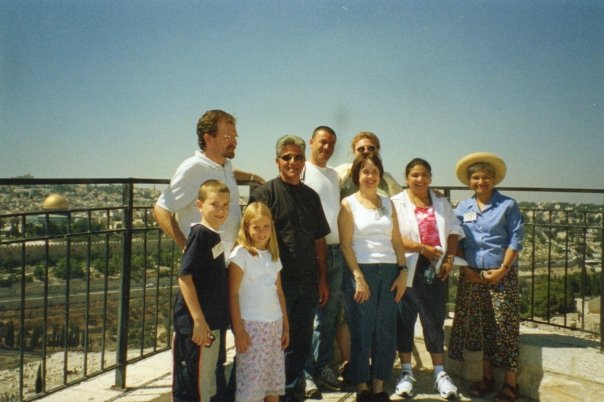
Some revolutionaries from all nations overlooking the Temple Mount, on our 2004 trip


I have actually heard people say they fear holding a bake sale anywhere on church property…they think a divine lightning bolt might drop.


Some go as far as to question the propriety of youth group fundraisers (even in the lobby), or flinch at setting up a table anywhere in a church building (especially the “sanctuary”) where a visiting speaker or singer sells books or CDs.  “I don’t want to get zapped!”


All trace their well-meaning concerns to the “obvious” Scripture:

"Remember when Jesus cast out the moneychangers and dovesellers?"

It is astounding how rare it is to hear someone comment on the classic "temple tantrum" Scripture without turning it into a mere moralism:


"Better not sell stuff in church!”

Any serious study of the passage concludes that the most obvious reason Jesus was angry was not commercialism, but:


racism.


I heard that head-scratching.


The tables the Lord was intent on overturning were those of prejudice.

I heard that “Huh?”


A brief study of the passage…in context…will reorient us:


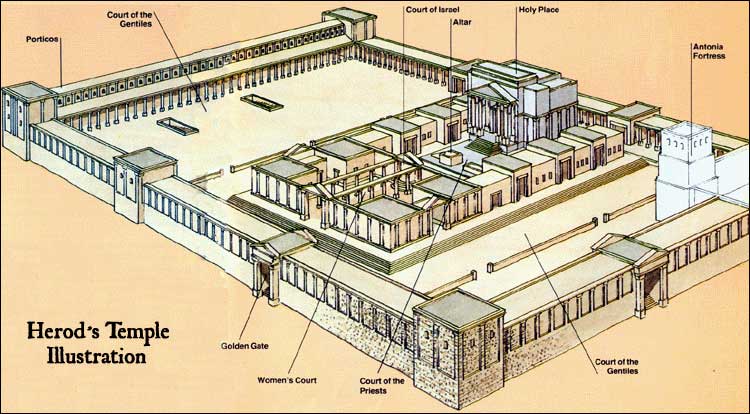
Again, most contemporary Americans assume that Jesus’ anger was due to his being upset about the buying and selling.  But note that Jesus didn't say "Quit buying and selling!” His outburst was, "My house shall be a house of prayer for all nations" (Mark 11:17, emphasis mine).   He was not merely saying what he felt, but directly quoting Isaiah (56:6-8), whose context is clearly not about commercialism, but adamantly about letting foreigners and outcasts have a place in the “house of prayer for all nations”; for all nations, not just the Jewish nation.   Christ was likely upset not that  moneychangers were doing business, but that they were making it their business to do so disruptfully and disrespectfully in the "outer court;”  in  the “Court of the Gentiles” (“Gentiles” means “all other nations but Jews”).   This was

the only place where "foreigners" could have a “pew” to attend the international prayer meeting that was temple worship.   Merchants were making the temple  "a den of thieves" not  (just) by overcharging for doves and money, but by (more insidiously) robbing precious people of  “all nations”  a place to pray, and the God-given right  to "access access" to God.


Money-changing and doveselling were not inherently the problem.  In fact they were required;  t proper currency and “worship materials” were part of the procedure and protocol.  It’s true that the merchants may  have been overcharging and noisy, but it is where and how they are doing so that incites Jesus to righteous anger.


The problem is never tables.  It’s what must be tabled:


marginalization of people of a different tribe or tongue who are only wanting to worship with the rest of us.


In the biblical era, it went without saying that when someone quoted a Scripture, they were assuming and importing the context.  So we often miss that Jesus is quoting a Scripture in his temple encounter, let alone which Scripture and  context.  Everyone back then immediately got the reference: “Oh, I get it, he’s preaching Isaiah, he must really love foreigners!”:

 Foreigners who bind themselves to the Lord…all who hold fast to my covenant-these I will bring to my holy mountain and give them joy in my house of prayer. Their burnt offerings and sacrifices will be accepted on my altar; for my house will be called a house of prayer for all nations.” (Isaiah 56:6-8, emphases mine)
Gary Molander, faithful Fresnan and cofounder of Floodgate Productions, has articulated it succinctly:

“The classic interpretation suggests that people were buying and selling stuff in God’s house, and that’s not okay.  So for churches that have a coffee bar, Jesus might toss the latte machine out the window.
I wonder if something else is going on here, and I wonder if the Old Testament passage Jesus quotes informs our understanding?…Here’s the point:
Those who are considered marginalized and not worthy of love, but who love God and are pursuing Him, are not out.  They’re in..

Those who are considered nationally unclean, but who love God and are pursuing Him, are not out.  They’re in.

God’s heart is for Christ’s Church to become a light to the world, not an exclusive club.  And when well-meaning people block that invitation, God gets really, really ticked.”
(Gary Molander, http://www.garymo.com/2010/03/who-cant-attend-your-church/)

Still reeling?  Hang on, one more test:


How often have you heard the Scripture  about “speak to the mountain and it will be gone” invoked , with the “obvious” meaning being “the mountain of your circumstances” or “the mountain of obstacles”?  Sounds good, and that will preach.   But again,  a quick glance at the context of that saying  of Jesus reveals nary a mention of metaphorical obstacles.   In fact, we find it (Mark 11:21-22) directly after the “temple tantrum.”  And consider where Jesus and the disciples are: still near the temple,  and still stunned by the  “object lesson” Jesus had just given there  about prejudice.  And know that everyone back then knew what most today don’t:  that one way to talk about the temple was to call it “the mountain” (Isaiah 2:1, for example: “the mountain of the Lord’s temple”) .


Which is why most scholars would agree with Joel Green and John Carroll:

“Indeed, read in its immediate context, Jesus’ subsequent instruction to the disciples, ‘Truly I tell you, if you say to this mountain..’ can refer only to the mountain on which the temple is built!... For him, the time of the temple is no more.”  (“The Death of Jesus in Early Christianity,” p. 32, emphasis mine).
In Jesus’ time, the temple system of worship had become far too embedded with prejudice.  So Jesus suggests that his followers actually pray such a system, such a mountain, be gone.


Soon it literally was.


In our day, the temple is us: the church.


And the church-temple  is called to pray a moving, mountain-moving, prayer:


“What keeps us from being a house of prayer for all nations?”


Or as Gary Molander summarizes:


“Who can’t attend your church?” -Dave Wainscott, Salt Fresno Magazine

-- 
--------------------
the money changers  were in the Gentile courts of the temple..Jesus' action opened up the plazaso that Gentiles could pray."  -Kraybill, Upside Down Kingdom, p. 151.
-----


--

FOR ALL THE NATIONS: BY RAY VANDER LAAN:

 Through the prophet Isaiah, God spoke of the Temple as ?a house of prayer for all the nations? (Isa. 56:7). The Temple represented his presence among his people, and he wanted all believers to have access to him.
Even during the Old Testament era, God spoke specifically about allowing non-Jewish people to his Temple: ?And foreigners who bind themselves to the Lord ? these I will bring to my holy mountain and give them joy in my house of prayer? (Isa. 56:7).
Unfortunately, the Temple authorities of Jesus? day forgot God?s desire for all people to worship freely at the Temple. Moneychangers had settled into the Gentile court, along with those who sold sacrificial animals and other religious merchandise. Their activities probably disrupted the Gentiles trying to worship there.
When Jesus entered the Temple area, he cleared the court of these moneychangers and vendors. Today, we often attribute his anger to the fact that they turned the temple area into a business enterprise. But Jesus was probably angry for another reason as well.
As he drove out the vendors, Jesus quoted the passage from Isaiah, ?Is it not written: ?My house will be called a house of prayer for all nations??? The vendors had been inconsiderate of Gentile believers. Their willingness to disrupt Gentile worship and prayers reflected a callous attitude of indifference toward the spiritual needs of Gentiles.
Through his anger and actions, Jesus reminded everyone nearby that God cared for Jew and Gentile alike. He showed his followers that God?s Temple was to be a holy place of prayer and worship for all believers. - Van Der Laan

---


--
Excerpts from a good Andreana Reale article in which she sheds light on Palm Sunday and theTemple Tantrum:
,, Jesus’ entrance into Jerusalem actually echoes a custom that would have been familiar to people living in the Greco-Roman world, when the gospels were written.
Simon Maccabeus was a Jewish general who was part of the Maccabean Revolt that occurred two centuries before Christ, which liberated the Jewish people from Greek rule. Maccabeus entered Jerusalem with praise and palm leaves—making a beeline to the Temple to have it ritually cleansed from all the idol worship that was taking place. With the Jewish people now bearing the brunt of yet another foreign ruler (this time the Romans), Jesus’ parade into Jerusalem—complete with praise and palm leaves—was a strong claim that He was the leader who would liberate the people.
Except that in this case, Jesus isn’t riding a military horse, but a humble donkey. How triumphant is Jesus’ “triumphant entry”—on a donkey He doesn’t own, surrounded by peasants from the countryside, approaching a bunch of Jews who want to kill Him?
And so He enters the Temple. In the Greco-Roman world, the classic “triumphant entry” was usually followed by some sort of ritual—making a sacrifice at the Temple, for example, as was the legendary case of Alexander the Great. Jesus’ “ritual” was to attempt to drive out those making a profit in the Temple.
The chaotic commerce taking place—entrepreneurs selling birds and animals as well as wine, oil and salt for use in Temple sacrifices—epitomized much more than general disrespect. It also symbolised a whole system that was founded on oppression and injustice.
In Matthew, Mark and John, for example, Jesus chose specifically to overturn the tables of the pigeon sellers, since these were the staple commodities that marginalised people like women and lepers used to be made ritually clean by the system. Perhaps it was this system that Jesus was referring to when He accused the people of making the Temple “a den of robbers” (Mt 21.13; Mk 11.17; Lk 19.46).
Andreana Reale


--

So Jesus is intertexting and ddouble pasting two Scriptures  and making a new one.
But he leaves out the most important part "FOR ALL NATIONS"...which means he is hemistiching and making that phrase even more significant by it's absence,
-----


"If anyone says to this mountain, 'Go throw yourself into the sea, and does not doubt in his heart but believes that what he says will happen, it will be done.'  (Mark 11:23). If you want to be charismatic about it, you can pretend this refers to the mountain of your circumstances--but that is taking the passage out of context.  Jesus was not referring to the mountain of circumstances.  When he referred to 'this mountain,' I believe (based in part on Zech  4:6-9) that he was looking at the Temple Mount, and indicating that "the mountain on which the temple sits is going to be removed, referring to its destruction by the Romans..


Much of what Jesus said was intended to clue people in to the fact that the religous system of the day would be overthrown, but we miss much if it because we Americanize it, making it say what we want it to say,  We turn the parables into fables or moral stories instead of living prophecies  that pertain as much to us as to the audience that first heard them."
-Steve Gray, "When The KIngdom Comes," p..31

“Indeed, read in its immediate context, Jesus’ subsequent instruction to the disciples, ‘Truly I tell you, if you say to this mountain..’ can refer only to the mountain on which the temple is built!... For him, the time of the temple is no more.” 

"The word about the mountain being cast into the sea.....spoken in Jerusalem, would naturallly refer to the Temple mount.  The saying is not simply a miscellaneous comment on how prayer and faith can do such things as curse fig trees.  It is a very specific word of judgement: the Temple mountain is, figuratively speaking, to be taken up and cast into the sea."
 -N,T. Wright,  "Jesus and the Victory of God," p.422 


see also:


By intercalating the story of the cursing of the fig tree within that of Jesus' obstruction of the normal activity of the temple, Mark interprets Jesus' action in the temple not merely as its cleansing but its cursing. For him, the time of the temple is no more, for it has lost its fecundity. Indeed , read in its immediate context, Jesus' subsequent instruction to the disciples, "Truly I tell you, if you say to this mountain, 'Be taken up and thrown into the sea'" can refer only to the mountain on which the temple is built!

What is Jesus' concern with the temple? Why does he regard it as extraneous to God's purpose?
Hints may be found in the mixed citation of Mark 11:17, part of which derives from Isaiah 56:7, the other from 11:7. Intended as a house of prayer for all the nations, the temple has been transformed by the Jewish leaders in Jerusalem into a den of brigands. That is, the temple has been perverted in favor of both socioreligious aims (the exclusion of Gentiles as potential recipients of divine reconciliation) and politico-economic purposes (legitimizing and
consolidating the power of the chief priests, whose teaching might be realized even in the plundering of even a poor widow's livelihood-cf 12:41-44)....

...In 12:10-11, Jesus uses temple imagery from Psalm 118 to refer to his own rejection and vindication, and in the process, documents his expectation of a new temple, inclusive of 'others' (12:9, Gentiles?) This is the community of his disciples.
-John T, Carroll and Joel B. Green, "The Death of Jesus in Early Christianity," p. 32-33


FIG TREE: FOLLOW SCRIPTURES WHERE IT IS A SYMBOL OF NATIONIAL ISRAEL/jERUSALEM/GOD'S BOUNDED SET:
=


Fig Tree:

s to the significance of this passage and what it means, the answer to that is again found in the chronological setting and in understanding how a fig tree is often used symbolically to represent Israel in the Scriptures. First of all, chronologically, Jesus had just arrived at Jerusalem amid great fanfare and great expectations, but then proceeds to cleanse the Temple and curse the barren fig tree. Both had significance as to the spiritual condition of Israel. With His cleansing of the Temple and His criticism of the worship that was going on there (Matthew 21:13Mark 11:17), Jesus was effectively denouncing Israel’s worship of God. With the cursing of the fig tree, He was symbolically denouncing Israel as a nation and, in a sense, even denouncing unfruitful “Christians” (that is, people who profess to be Christian but have no evidence of a relationship with Christ).
The presence of a fruitful fig tree was considered to be a symbol of blessing and prosperity for the nation of Israel. Likewise, the absence or death of a fig tree would symbolize judgment and rejection. Symbolically, the fig tree represented the spiritual deadness of Israel, who while very religious outwardly with all the sacrifices and ceremonies, were spiritually barren because of their sins. By cleansing the Temple and cursing the fig tree, causing it to whither and die, Jesus was pronouncing His coming judgment of Israel and demonstrating His power to carry it out. It also teaches the principle that religious profession and observance are not enough to guarantee salvation, unless there is the fruit of genuine salvation evidenced in the life of the person. James would later echo this truth when he wrote that “faith without works is deadt also teaches the principle that religious profession and observance are not enough to guarantee salvation, unless there is the fruit of genuine salvation evidenced in the life of the person. James would later echo this truth when he wrote that “faith without works is dead” (James 2:26). The lesson of the fig tree is that we should bear spiritual fruit (Galatians 5:22-23), not just give an appearance of religiosity. God judges fruitlessness, and expects that those who have a relationship with Him will “bear much fruit” ( LINK


T


--


__


--


--
 Quiz next week will be exactly this list..
Definitions and answers given on Week 1 post here, and Week 2 post here
a  inclusio
b   chiasm
c  fuzzy set
d Kingdon
e  centered set
f   bounded sert
g  drop-down box
h Middle Zone
i  six dregrees of separatio
j  three worlds
k  intertextuality/hyperlinking
l   recurrence


There will be an exra page on the quiz with the three extra crdit subols we did tonight..see above: intercalation/sandwiching, double paste,  and hemistichje.


SKIP ALL the homework for next week, except reading Proverbs 10-15 

-2 points: post in the comments any tough Bible/God/religion question.  I will address them next week.
-2 points: bring a stack of magazines you don't need next week, and the week after (for a project we'll do last day of class.

--

Finally, here is the syllabus for your next Bible class, 300B.  We noted:

-all the work is due before class
-this includes a church visit and service project.
-Be sure to follow instructions about what kind of church to visit.


No comments:

Post a Commen